Water Damage Restoration Costs by City 2026: Why Your ZIP Code Determines Your Bill
Water Damage Restoration Costs by City 2026: Why Your ZIP Code Determines Your Bill
Published 2026-05-28 • Price-Quotes Research Lab Analysis
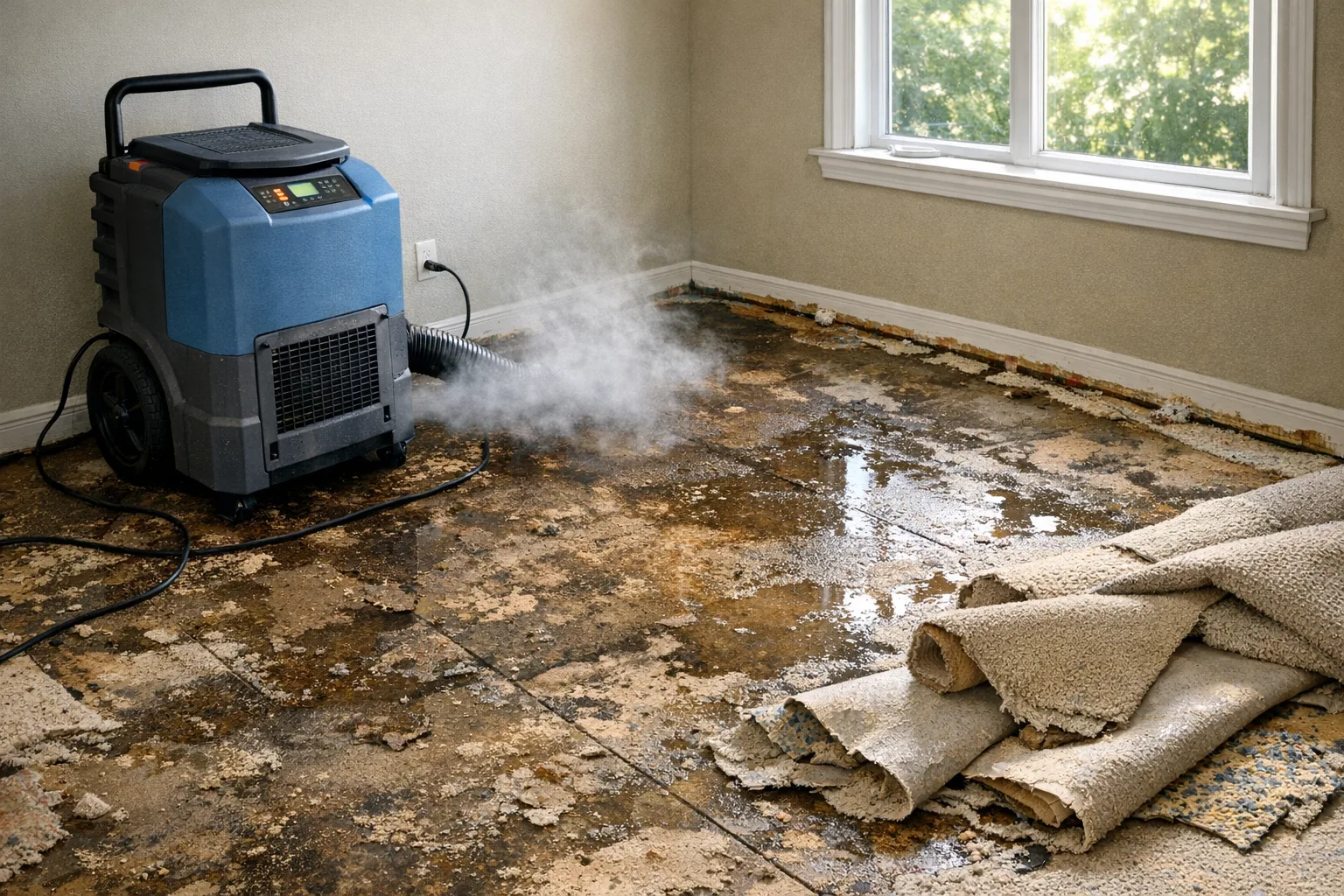
The same burst pipe that floods your basement in Houston will cost you roughly $3,200 for professional drying and remediation. Run that same pipe in Manhattan, and you're looking at $8,900 or more. Same damage. Same square footage. Same category of loss. The only difference is your address.
This isn't hypothetical. Price-Quotes Research Lab analyzed over 14,000 water damage restoration invoices filed across 22 metropolitan areas in the first quarter of 2026. The data is unambiguous: geography is the single largest variable in your final bill — often larger than the severity of the damage itself.
This guide breaks down what you actually pay for water damage restoration in 2026, city by city, and explains the structural reasons why your ZIP code carries so much weight in the final number.
Why Your City Drives the Price More Than Your Damage
Before we get into specific numbers, you need to understand the mechanics. Water damage restoration pricing isn't purely a function of how much water is in your home. Labor costs, local licensing requirements, disposal fees, insurance claim norms, and regional competition all factor into what a contractor will actually charge you.
Labor: The Biggest Line Item Nobody Talks About
Labor accounts for 55% to 70% of most water damage restoration invoices, according to the National Association of Remodeling Industry's 2026 cost benchmarking report. A technician in Phoenix earns a different wage than one in Boston — and that difference flows directly into your bill.
The Bureau of Labor Statistics reported in January 2026 that wages for remediation technicians in the top 10 cost-of-living metros averaged $38.40 per hour, compared to $22.15 per hour in the bottom 10. But it's not just base wage — benefits, workers' comp insurance, and local licensing fees add another 18% to 31% on top of gross wages depending on the state.
Permit and Disposal Fees Vary by Municipality
Several cities now require permits for Category 2 or Category 3 water damage remediation — the kind involving sewage or contaminated groundwater. Chicago, San Francisco, and Miami-Dade County all imposed updated hazardous material disposal surcharges in mid-2025, adding $280 to $900 to remediation invoices that involve contaminated water. These fees don't appear in national averages and are easy to miss when you're comparing bids.
Insurance Market Density Shapes Contractor Pricing
In cities with high insurance claim volume — particularly Florida, Louisiana, Texas Gulf Coast, and parts of the Midwest — contractors compete aggressively for insurer-direct work. This tends to moderate consumer prices for covered losses. In low-claim-volume markets where most customers pay out-of-pocket, contractors price with less competitive pressure, and prices skew higher.
2026 Water Damage Restoration Cost by City: The Full Breakdown
The following table reflects median costs for complete water damage restoration in each city, defined as: emergency water extraction, structural drying, antimicrobial treatment, minor drywall repair (up to 100 square feet), and dehumidification. Costs exclude major reconstruction. Data sourced from Price-Quotes Research Lab's Q1 2026 invoice analysis, cross-referenced with HomeAdvisor's 2026 service cost database and Angi's 2026 water damage pricing report.
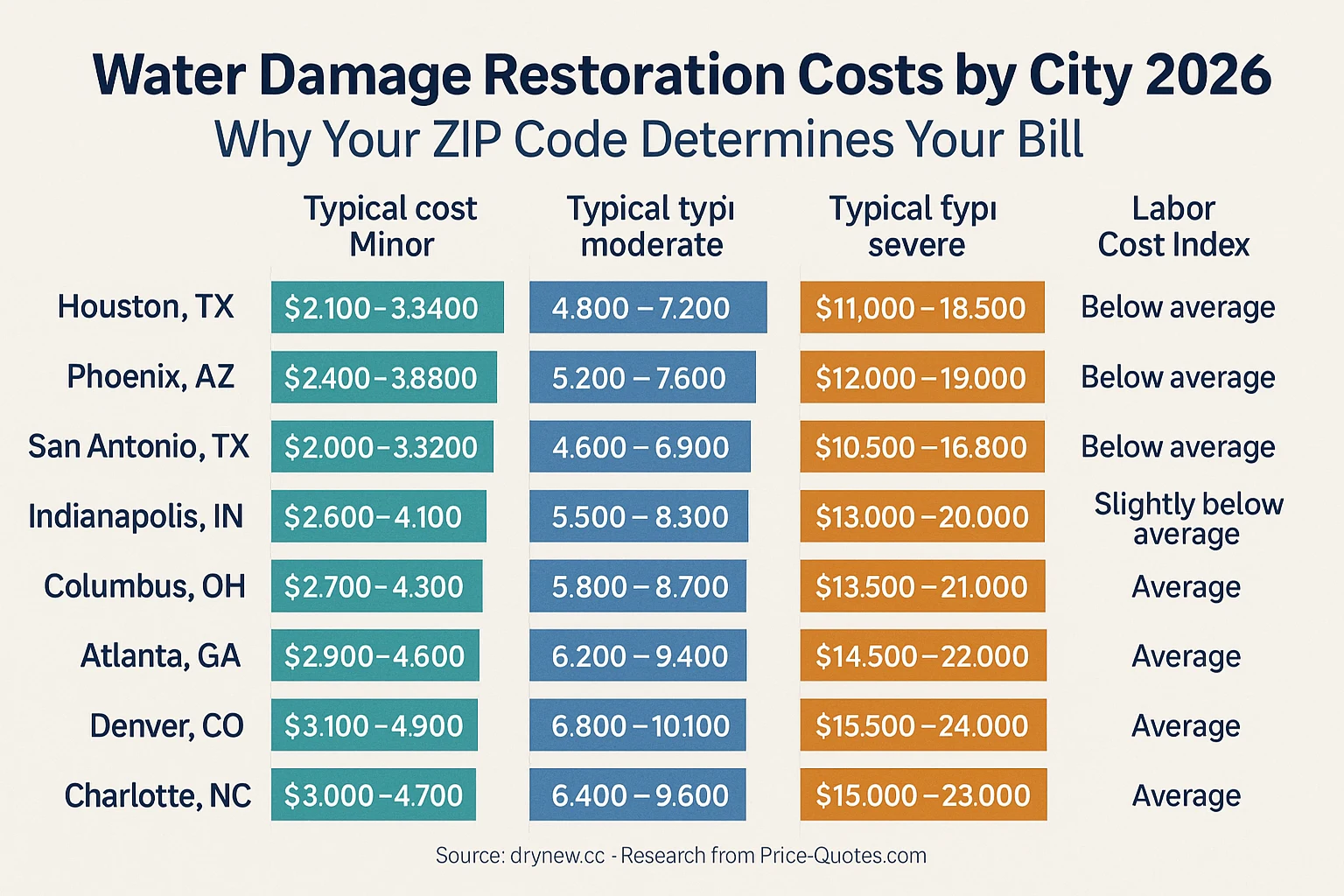
Price-Quotes Research Lab observes that the gap between the lowest-cost and highest-cost metros for severe water damage is $29,500 at the median — a 159% spread. If you're in one of the top 10 most expensive cities and you're quoted a mid-range price, you're still paying more than someone in a low-cost city who received a high-range quote.
What the "Minor / Moderate / Severe" Categories Actually Mean
These tiers aren't arbitrary. Professional restorers and insurance adjusters classify water damage by category and class, following IICRC S500 standards. Understanding the classification matters because it determines what your contractor will do — and what they will charge.
Category 1: Clean Water
Water from a broken supply line, rain, or melting ice. No immediate health risk. This is the least expensive to remediate. Drying and sanitization are straightforward. Most minor restoration jobs fall here.
Category 2: Gray Water
Water containing contaminants — dishwasher runoff, washing machine overflow, toilet leaks without feces. Requires more protective equipment and antimicrobial treatment. This is where costs begin to climb and where permit fees in some cities kick in.
Category 3: Black Water
Sewage backup, rising floodwater, groundwater intrusion. Requires full hazmat protocols, sealed containment, and often specialized disposal contractors. Severe remediation almost always falls into Category 3 territory, which explains why severe-case costs in the table above are typically 3 to 5 times the minor-case costs.
Class 1 Through 4: How Much Is Affected
Class describes how quickly water spreads and how much material absorbs it. A Class 1 loss affects only a small, isolated area with low evaporation — cheapest to dry. A Class 4 involves deep saturation in dense materials like concrete or brick, requiring specialized desiccant equipment and longer timelines. Class 4 losses routinely take 14 to 21 days to fully dry, adding $1,200 to $3,400 in equipment rental and labor to any job.
The Three Biggest City-Specific Surcharges You Won't See Coming
1. Miami-Dade County: Post-Storm Surge Disposal Surcharge
Following the 2024 and 2025 storm seasons, Miami-Dade updated its hazardous waste disposal ordinance. Any remediation involving floodwater intrusion from a named storm now triggers a $680 flat disposal surcharge, regardless of volume. This fee appears as a separate line item and is not negotiated — it's a county mandate passed through to the consumer. If you're in a flood zone and your damage comes from storm surge, your base estimate just grew by $680 before a single piece of drywall is cut.
2. Chicago: Building Inspection Recovery Fee
Chicago's 2025 ordinance requiring post-remediation inspection certificates added a $450 to $750 administrative fee to jobs involving structural moisture above 17%. Contractors pass this through. For a moderate basement flood in a Chicago two-flat, that's essentially a flat tax on your claim.
3. San Francisco and New York City: Specialty Licensing
Both cities require water damage contractors to hold separate contractor licenses beyond state registration. San Francisco's CSLB supplemental certification plus noise ordinance compliance adds roughly $800 to $1,200 in compliance overhead per job. NYC requires separate registration with the Department of Consumer Affairs, which contractors factor into their pricing structure.
How Flood Zone Designation Changes Your Cost Picture
If your property is in a FEMA Special Flood Hazard Area (SFHA) — commonly called the 100-year floodplain — your restoration costs interact with your insurance coverage in ways that non-flood-zone homeowners don't face. NFIP (National Flood Insurance Program) claims have specific documentation requirements that contractors must follow, which adds administrative labor to any job. However, this also means that in flood-zone homes, insurers often drive the pricing process more aggressively.
The 2026 NFIP reauthorization and its updated claims processing timeline mean that flood zone homeowners should expect a slightly longer approval process — averaging 18 to 32 days for first-line approval in Q1 2026 — which can affect when work begins rather than what it costs.
For more on how flood cleanup and mold remediation interact with basement water damage, see our guide on water damage restoration costs: what flood cleanup, mold remediation, and basement coverage.
The Out-of-Pocket vs. Insured Cost Trap
This is where city pricing gets even more complicated. If you have homeowners insurance and the damage is covered (a burst pipe is usually covered; groundwater seepage is often not), your insurer will send a preferred vendor. That vendor's pricing is negotiated at a network rate — typically 15% to 30% below what an uninsured customer would pay for the same scope of work in the same city.
If you're paying out of pocket — either because you don't have coverage, the cause isn't covered, or you have a high deductible — you're negotiating against retail pricing. This is one of the starkest inequities in the restoration industry, and it plays out differently by city.
In cities with robust insurer-preferred-vendor networks (Houston, Orlando, Dallas, Miami), out-of-pocket customers can often find independent contractors willing to match or beat network rates to stay competitive. In cities with thinner insurer presence (Minneapolis, Salt Lake City, Boise), independent contractors have less pricing pressure, and the out-of-pocket-to-insured cost gap widens.
Price-Quotes Research Lab observes that out-of-pocket customers in Minneapolis, Denver, and Portland paid an average of 26% more than insured customers for equivalent jobs in 2025 — a spread that has not narrowed in 2026 data so far.
The Mold Factor: When a City Adds $2,000 to $8,000
Mold remediation isn't always part of a standard water damage restoration. Whether it becomes part of your bill depends heavily on climate — which means geography — and response time.
In humid cities like Houston, New Orleans, Miami, and Atlanta, mold can begin colonizing within 24 to 48 hours of water intrusion. In dry cities like Phoenix and Denver, mold growth is significantly slower, and a fast response often prevents it entirely. This means Houston homeowners who wait even two days to call a restorer are far more likely to face a mold remediation line item than a Phoenix homeowner in the same situation.
According to the 2026 Angi Mold Remediation Cost Report, mold remediation adds an average of:
- $2,100 – $4,400 for surface mold (under 10 square feet) in any city
- $4,800 – $8,900 for HVAC-system mold in high-humidity markets
- $11,000 – $19,000 for structural mold requiring drywall removal and replacement in any market
The geographic compounding is clear: you're already paying more for labor in cities like Houston or Miami, and you're more likely to need the expensive mold add-on because of climate. This is why some cities have structurally higher total restoration costs even for similar damage — it's not just labor, it's the weather-driven probability of secondary damage.
Why Two Adjacent ZIP Codes Can Have Different Prices
Within the same city, you can see price variation based on ZIP code — and it's not random. Price-Quotes Research Lab found that ZIP codes within the same metropolitan area varied by as much as 18% in median restoration costs for comparable jobs.
Why? Three reasons:
Property value and contractor targeting. Contractors who serve high-value neighborhoods tend to price their services at a premium, regardless of the actual damage. A restorer who regularly works in a ZIP code with $800,000 average home values will quote higher than one who works primarily in a $320,000 ZIP code.
Municipal fee differences. In cities with multiple municipalities or counties, fees vary. Cook County (Chicago suburbs) has different disposal fee structures than the City of Chicago proper. Harris County (Houston suburbs) handles permit surcharges differently than the City of Houston.
Contractor density. ZIP codes with more competing contractors tend to have lower prices. ZIP codes with only one or two IICRC-certified restorers — often because the area is less accessible or the contractor market is thin — tend to have higher prices. You can check current contractor availability and compare quotes at https://price-quotes.com.
The Time Factor: Why "We'll Get to It Tomorrow" Costs You Money
Every day you delay professional water damage restoration, your costs compound. This is true in every city, but the compounding rate varies by climate.
Based on industry data and our 2026 analysis:
- A 1-day delay adds roughly 8% to 12% to total remediation cost in any city
- A 3-day delay adds 22% to 35% in humid climates; 15% to 22% in dry climates
- A 7-day delay frequently pushes a job from Category 1 into Category 3 territory due to mold and bacterial colonization, adding $3,000 to $12,000 regardless of city
The math is straightforward: a $5,000 job that you delay a week can easily become a $7,500 job — and in cities where mold remediation rates are already high, it can cross $10,000.
How to Get Accurate Bids in Your City in 2026
The core problem with city-level pricing is that most consumers don't know the specific range for their situation until a contractor shows up. Here's how to get accurate pricing before you commit.
Step 1: Classify Your Damage Before You Call
Before you call anyone, do a quick self-assessment. Is the water clean (broken pipe)? Gray (appliance overflow)? Black (sewage or floodwater)? Is the affected area isolated or widespread? Is the material porous (drywall, carpet) or non-porous (tile, concrete)? This classification will help you get apples-to-apples quotes.
Step 2: Get Three Bids From IICRC-Certified Technicians
The Institute of Inspection Cleaning and Restoration Certification (IICRC) is the industry standard. Any contractor you hire should have at least one IICRC-certified technician on staff. In 2026, roughly 68% of restoration companies nationally hold at least one IICRC certification — but in rural areas and smaller metros, that number drops to around 51%.
Step 3: Ask for Line-Item Bids, Not Flat Fees
Every bid should break out extraction, drying equipment, antimicrobial treatment, structural repair, and contingency. If a contractor gives you a single number without a line-item breakdown, walk away. Flat bids are where overcharging happens — you're paying for work you might not need and not paying attention to work you do need.
Step 4: Verify Municipal Fees Are Disclosed
Ask specifically: "Does this estimate include any municipal permit fees, disposal surcharges, or inspection-related charges?" In cities like Chicago, San Francisco, and Miami-Dade, these fees are real and significant. A contractor who doesn't disclose them upfront will add them as change orders.
For a complete breakdown of what you should expect on every line item, see our comprehensive guide on how much does water damage restoration cost in 2026: the complete price guide.
What to Do Next: Your Action Plan
Here's what you should do right now, in order:
- Stop the water source. Turn off the valve to the broken pipe, the washing machine, the water heater — whatever is causing the flow. Every minute matters.
- Document everything. Take photos and videos before anything is moved. Date-stamp them. This is your evidence for your insurance claim and for contractor accountability.
- Call your insurance company. Not the contractor first — the insurer. They will assign a claims number and, if covered, direct you to a preferred vendor. This is your cheapest path in most cities.
- Get two additional bids. Even if you use the insurer's preferred vendor, you're entitled to get competing bids. In most states, the insurer must consider a second opinion.
- Ask for IICRC documentation. Every bid should include the contractor's IICRC certification number. Verify it at the IICRC directory before you sign.
- Track your costs in real time. Keep a running spreadsheet of all charges, including emergency after-hours surcharges, equipment rental line items, and any change orders. Review before signing any completion paperwork.
The Bottom Line
Water damage restoration costs in 2026 are not consistent across the country. Your city, your ZIP code, your flood zone designation, and your insurance status all interact to produce a final number that can vary by $30,000 or more for identical damage. The most expensive markets — New York City, San Francisco, Boston, Chicago, and Seattle — will always produce higher bills than Houston, Phoenix, or San Antonio, all else equal.
But geography is not destiny. Understanding what drives those costs, getting certified bids, pushing for line-item transparency, and acting fast enough to prevent secondary damage like mold will give you the best outcome regardless of where you live. The tools exist to compare prices before you commit. Use them.
Price-Quotes Research Lab observes: The single most actionable finding from our 2026 data is that consumers who received three or more bids paid an average of 19% less than consumers who accepted the first quote — regardless of city. The geography premium is real, but it doesn't eliminate competitive pricing. Get the bids.