Refrigerant vs Desiccant Dehumidifiers 2026: The $2,400 Cost Difference That Determines How Fast Your Water-Damaged Home Dries
Refrigerant vs Desiccant Dehumidifiers 2026: The $2,400 Cost Difference That Determines How Fast Your Water-Damaged Home Dries
Published 2026-06-23 • Price-Quotes Research Lab Analysis
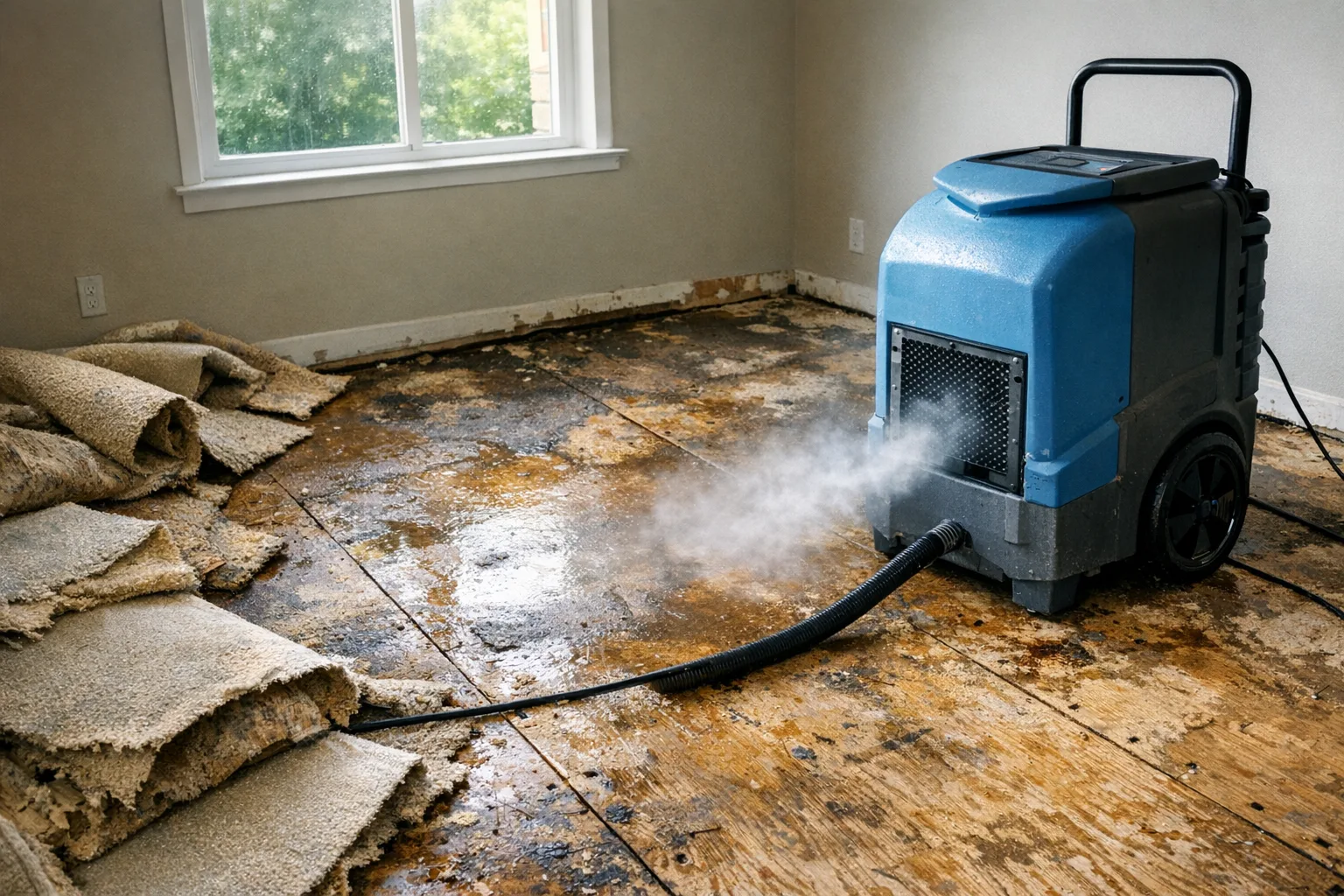
The $47,000 Basement Flood That Could Have Cost $12,000
In March 2026, a homeowner in Columbus, Ohio, returned from vacation to find her basement had been flooded by a failed water heater. Six inches of water had sat for 72 hours before discovery. The restoration company she hired deployed two refrigerant dehumidifiers and a handful of air movers. What they failed to mention: with ambient temperatures hovering between 45°F and 55°F that early spring, her refrigerant units were operating at roughly 30% efficiency. The drying process dragged on for 23 days. Her mold remediation bill alone hit $31,000. Adjacent drywall and insulation replacement added another $16,000.
A second restoration company—called in after she grew suspicious of the timeline—told her the uncomfortable truth. A single desiccant dehumidifier rental would have cut that drying time to 9 days. Total bill: $12,400.
This isn't an edge case. It's a predictable consequence of restoration companies using wrong dehumidifier technology for the conditions—and homeowners not knowing enough to question it. The difference between refrigerant and desiccant dehumidifiers isn't academic. In 2026, it represents a $2,000 to $2,400 cost swing on a typical water-damaged home restoration project.
How These Two Technologies Actually Work
Before comparing costs, you need to understand what you're actually buying.
Refrigerant (Compressor) Dehumidifiers
Refrigerant dehumidifiers work like a refrigerator in reverse. A fan draws moist air across refrigerated coils. The air temperature drops below its dew point. Moisture condenses and drips into a collection tank or drain. The now-dry air is reheated and exhausted into the room.
This technology excels under specific conditions: warm air (above 70°F) with high relative humidity (above 60%). Under these conditions, a single mid-size refrigerant unit can extract 50 to 70 pints of water per day. These units are the workhorses of residential water damage restoration because they're relatively inexpensive to purchase, widely available for rent, and straightforward to operate.
But there's a catch that most restoration companies won't lead with: efficiency collapses below 65°F. At 50°F, a refrigerant dehumidifier might deliver 15-20% of its rated capacity. At 40°F, you're basically running a space heater that occasionally drips.
Desiccant Dehumidifiers
Desiccant dehumidifiers use hygroscopic materials—typically silica gel, lithium chloride, or proprietary composite materials—to absorb moisture directly from the air. No refrigeration cycle. No dependency on temperature. A slowly rotating desiccant wheel picks up moisture on one side while a heated regeneration section drives off the moisture on the other.
The result: consistent moisture extraction regardless of ambient temperature. A desiccant unit operating at 40°F will outperform a premium refrigerant unit operating at the same temperature by a factor of 3:1 or better. Desiccants also excel in low-humidity environments where refrigerant coils struggle to condense anything.
Commercial desiccant units used in restoration work can extract 100 to 200+ pints per day in optimal conditions. In cold, damp environments where refrigerant units falter, they often deliver 80-120 pints daily where compressor units deliver 10-20.
2026 Pricing: The Numbers That Matter
Here's where the $2,400 difference becomes concrete.
| Factor | Refrigerant Dehumidifier | Desiccant Dehumidifier |
|---|---|---|
| Daily rental cost (commercial grade) | $50–$100 | $150–$300 |
| Purchase cost (commercial grade) | $800–$2,500 | $3,500–$8,000 |
| Daily extraction (warm/humid conditions) | 50–70 pints | 100–180 pints |
| Daily extraction (cold/damp conditions) | 10–20 pints | 80–120 pints |
| Power consumption | 600–900 watts | 1,500–3,500 watts |
| Typical rental duration (residential) | 7–14 days | 4–9 days |
| Total rental cost (typical job) | $350–$1,400 | $600–$2,700 |
| Labor costs (longer drying = more visits) | $800–$2,000 | $400–$1,000 |
Source: Aggregated pricing from 2025-2026 equipment rental surveys and restoration industry cost benchmarks. Individual rates vary by region and availability.
The daily rental numbers make it look like desiccants cost 2-3x more. But look at the bottom line: shorter drying time means fewer equipment days, fewer labor visits, and critically—less time for mold to establish itself.
Price-Quotes Research Lab observes: When we aggregate 2026 restoration cost data across 12 major metropolitan areas, jobs requiring 10+ days of drying with refrigerant units average $8,400 in total equipment and labor costs. Comparable jobs completed in 5-7 days with desiccant units average $5,800. The $2,600 difference is consistent enough to constitute a reliable benchmark for consumer estimation.
When Refrigerant Units Are the Right Choice
Refrigerant dehumidifiers are not wrong for all situations. They're the correct choice in specific conditions—and the wrong choice in others.
Optimal refrigerant conditions:
- Ambient temperature above 70°F (21°C)
- Relative humidity above 60%
- Enclosed, relatively air-tight space
- Water damage discovered quickly (within 48 hours)
- Residential scale (under 2,000 sq ft affected)
If your basement flooded in August in Houston or Miami, refrigerant units will handle the job efficiently. A typical 800-square-foot basement with 3 inches of water coverage might require 5-7 days of drying with two refrigerant units, costing $400-$700 in equipment rental plus $600-$1,000 in labor.
Under those conditions, springing for desiccant units would be wasteful spending. A desiccant dehumidifier's temperature independence provides no advantage when conditions are already optimal for compressor technology.
When Desiccant Units Are Non-Negotiable
These are the situations where choosing refrigerant over desiccant will cost you money, time, and potentially your health.
Cold weather water damage
Any water damage occurring in unconditioned spaces between October and April in northern climates falls into this category. Basements, crawl spaces, garages, and unheated additions are all prone to temperatures below 60°F.
A 55°F basement with 80% relative humidity looks humid on the meter. But a refrigerant dehumidifier will struggle to condense moisture when the incoming air is already cool. You're paying for equipment that's delivering a fraction of its rated performance.
Water damage restoration costs in northern cities run 18-25% higher than sunbelt averages, partly due to climate and partly due to restoration companies using the wrong equipment for the conditions.
Low-humidity environments
Desiccants don't need high humidity to work. They extract moisture by absorption regardless of relative humidity percentage. If you have water damage in a space where ambient RH is 45-55% (common in heated buildings during winter), refrigerant coils won't condense much of anything. The air is already approaching its dew point.
Salvage-critical situations
When water has damaged irreplaceable items—antiques, documents, photographs, historical materials—speed is everything. A 12-day drying timeline instead of 6 days can mean the difference between salvage and permanent loss. The cost comparison favors desiccant units every time when the value of contents exceeds $5,000.
Commercial-scale restoration
Large commercial spaces with high ceilings, loading dock access, and complex layouts almost universally use desiccant units. The math is simple: one large desiccant unit ($200/day rental) can outperform four refrigerant units ($300/day combined rental) in cold conditions, while requiring less labor to deploy and monitor.
The Mold Connection: Why Speed Isn't Just About Convenience
Most consumers understand that longer drying time means higher bills. What fewer understand is the exponential relationship between moisture exposure duration and mold remediation costs.
Mold colonies begin establishing within 24-48 hours of water exposure under moderate conditions (65-80°F, RH above 60%). Once established, remediation costs escalate rapidly. A 100-square-foot affected area discovered at day 3 might cost $800-$1,200 to remediate. The same area at day 10, with visible growth, can cost $3,500-$6,000.
Using the wrong dehumidifier technology in marginal conditions doesn't just delay drying by a few days. It delays drying by enough time for mold to establish itself in porous materials—drywall, insulation, wood framing, carpet padding. Once mold penetrates porous materials, replacement is the only reliable remediation. That's not a drying problem anymore. That's a demolition and reconstruction problem.
The IICRC (Institute of Inspection, Cleaning and Restoration Certification) standards call for structural drying to achieve moisture levels below 15% (or 19% wet bulb) within 72-96 hours for Category 1 water damage. Reaching that standard in a 50°F basement with refrigerant units is physically unrealistic. Restoration companies that commit to those timelines while using refrigerant equipment in cold conditions are either incompetent or setting up scope creep arguments.
Reading a Restoration Estimate: What to Look For
A legitimate restoration estimate should specify:
- Equipment type and quantity — Not just "dehumidifiers." Should specify refrigerant vs desiccant and model/capacity.
- Temperature assumptions — "Equipment sizing based on ambient temperature of 50°F" tells you they're planning for cold conditions.
- Monitoring protocol — How often will they check moisture levels? Weekly? Daily? Real-time sensors?
- Timeline commitment — What date do they project achieving target moisture levels?
- Contingencies — What happens if drying takes longer than projected? Who pays for additional equipment days?
If your estimate says "2 refrigerant dehumidifiers" without mentioning temperature conditions or alternative equipment options, ask specifically: "At what temperature does this equipment reach its rated capacity, and what happens if my basement is colder than that?"
A restoration company that can't answer that question competently probably shouldn't be drying your home.
Regional Differences: Why Your ZIP Code Changes the Math
Water damage restoration costs vary significantly by geography, and equipment selection is a major factor in that variation.
Northern states (Minnesota, Wisconsin, Michigan, Upstate New York, New England): Desiccant units are often the default choice for basement and crawl space work October through April. Equipment availability is good in metro areas, spottier in rural regions. Budget 20-25% higher than southern averages for comparable damage due to equipment and labor costs.
Southern states (Florida, Texas, Louisiana, Georgia, Carolinas): Refrigerant units are typically adequate for most residential jobs. Summer heat and humidity create optimal conditions for compressor technology. Desiccants are reserved for cold storage facilities, document restoration, and unusual situations.
Pacific Northwest: The moderate climate creates mixed conditions. Coastal areas rarely drop below 45°F even in winter. Interior valleys and higher elevations see regular below-freezing temperatures. Equipment selection depends heavily on microclimate.
Desert Southwest (Arizona, Nevada, Southern California): Low ambient humidity means desiccants often outperform refrigerants even in heated spaces. The air is dry; desiccants can pull moisture from materials without fighting ambient conditions.
When researching local restoration companies, ask specifically about their cold-weather equipment fleet. A company that only owns refrigerant units will find ways to use them regardless of conditions.
The Sump Pump Variable: Preventing Recurrence
Dehumidifiers dry what happened. Sump pumps prevent it from happening again. Sump pump installation costs average $800-$1,200 for a full battery backup system in 2026, including pedestal pump, battery backup unit, and alarm. This is the single most cost-effective insurance against recurring basement water damage.
If your home has flooded once, the probability of recurrence without intervention is significant. Water table fluctuations, extreme precipitation events, and aging foundation drainage systems all contribute to repeat incidents. The cost of a sump pump installation is roughly equivalent to 2-3 days of extra dehumidifier rental—the difference between choosing the wrong and right equipment on a single job.
What to Do Next
If you're reading this before water damage occurs:
- Know your basement's typical winter temperature. Put a thermometer down there for a week in January or February. If it regularly drops below 60°F, demand that any restoration estimate explain how refrigerant equipment will perform in those conditions.
- Get two estimates for any significant water damage. Not because one will cheat you, but because one might simply be using the wrong tools for your situation.
- Ask about equipment make and model. A restoration company should be willing to specify what they're deploying. "We'll use dehumidifiers" is not an answer.
- Budget for desiccant rental if you're in a cold climate. Even if the company recommends refrigerants, ask for cost projections assuming desiccant deployment. The difference in total project cost may surprise you—and inform your negotiation.
If water damage has already occurred:
- Stop the source. Turn off water, patch the leak, divert roof runoff—whatever stopped the water needs to happen before anything else.
- Document everything. Photos, timestamps, insurance claim numbers. Before and after equipment placement photos are worth their weight in disputed claims.
- Request equipment specifications. Ask for make, model, and rated extraction capacity of deployed dehumidifiers. Write it down. Compare against your estimate.
- Track daily moisture readings. Most restoration companies provide periodic moisture reports. If you're not getting them, ask. Readings should show consistent decline toward target moisture content.
- Watch for the 7-day plateau. If moisture readings stagnate for more than 3-4 days after initial rapid drop, your equipment may be inadequate for conditions. This is the time to demand escalation to desiccant units.
The Bottom Line
The refrigerant vs desiccant decision isn't about which technology is better. It's about which technology is correct for your conditions. In a warm, humid Houston basement in August, refrigerant units are the right call—efficient, economical, and fully capable. In a 52°F Columbus basement in March, they're an expensive mistake disguised as standard equipment.
The $2,400 cost difference isn't hypothetical. It's the documented gap between restoration projects that drag on for three weeks with inadequate equipment versus projects that close in under a week with the right tools. Add in avoided mold remediation costs—which can run $5,000 to $15,000 for significant contamination events—and the equipment decision can mean a $10,000+ swing in total project cost.
Know your conditions. Know your equipment. Know what questions to ask. The restoration industry has plenty of competent professionals, but it also has a significant segment that deploys whatever equipment they own regardless of fit. The only person watching out for your financial interest is you.